Documentation

Connecting Chronograf to InfluxDB Enterprise clusters

The connection details form requires additional information when connecting Chronograf to an InfluxDB Enterprise cluster.

When you enter the InfluxDB HTTP bind address in the Connection String input, Chronograf automatically checks if that InfluxDB instance is a data node. If it is a data node, Chronograf automatically adds the Meta Service Connection URL input to the connection details form. Enter the HTTP bind address of one of your cluster’s meta nodes into that input and Chronograf takes care of the rest.
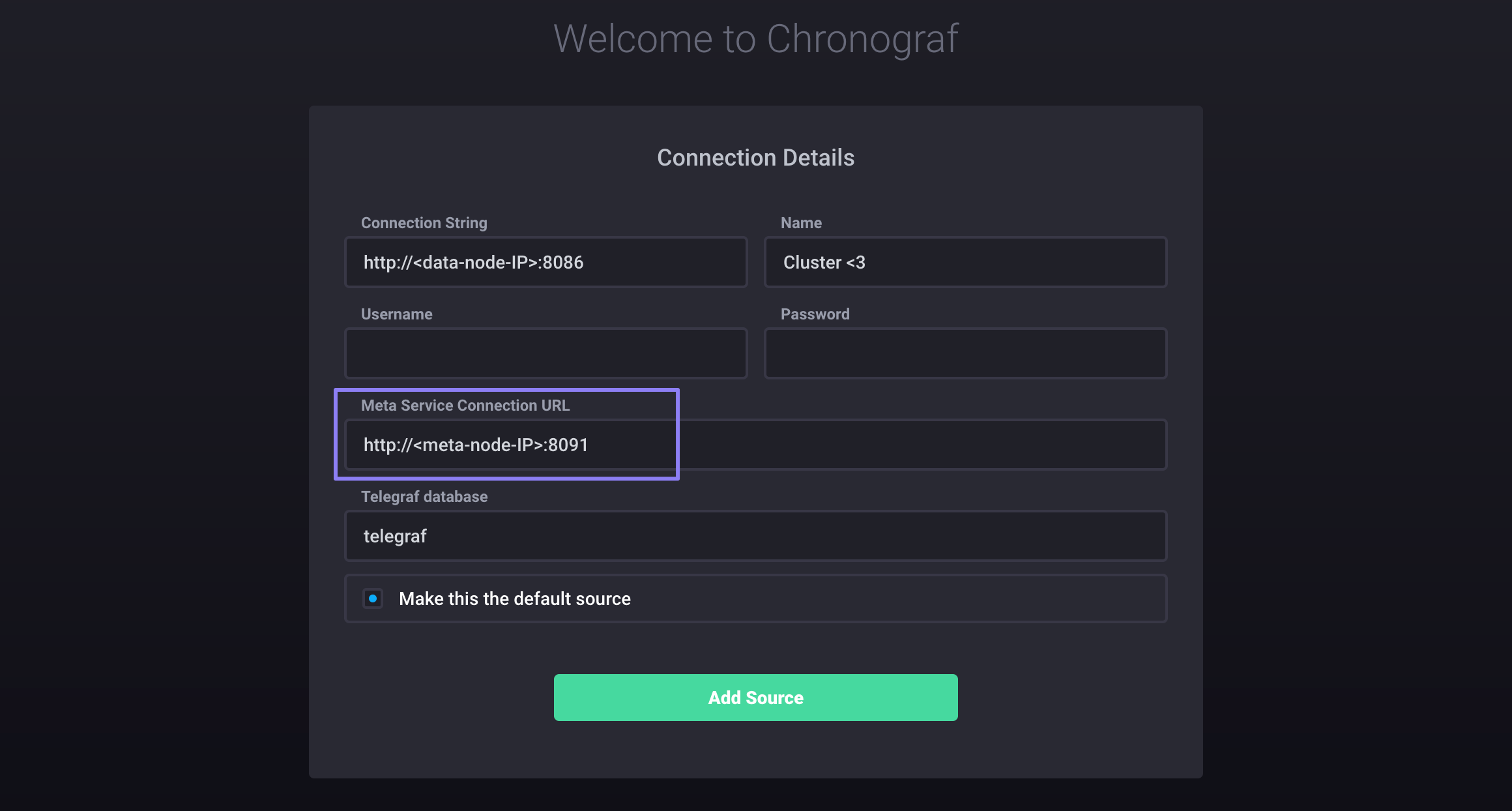
Cluster connection details

Note that the example above assumes that you do not have authentication enabled. If you have authentication enabled, the form requires username and password information.

For details about monitoring InfluxDB Enterprise clusters, see Monitoring InfluxDB Enterprise clusters.


Was this page helpful?

Thank you for your feedback!


Telegraf Enterprise now in public beta

Get early access to the Telegraf Controller and provide feedback to help shape the future of Telegraf Enterprise.

See the Blog Post

The upcoming Telegraf Enterprise offering is for organizations running Telegraf at scale and is comprised of two key components:

  • Telegraf Controller: A control plane (UI + API) that centralizes Telegraf configuration management and agent health visibility.
  • Telegraf Enterprise Support: Official support for Telegraf Controller and Telegraf plugins.

Join the Telegraf Enterprise beta to get early access to the Telegraf Controller and provide feedback to help shape the future of Telegraf Enterprise.

For more information:

InfluxDB Docker latest tag changing to InfluxDB 3 Core

On May 27, 2026, the latest tag for InfluxDB Docker images will point to InfluxDB 3 Core. To avoid unexpected upgrades, use specific version tags in your Docker deployments.

If using Docker to install and run InfluxDB, the latest tag will point to InfluxDB 3 Core. To avoid unexpected upgrades, use specific version tags in your Docker deployments. For example, if using Docker to run InfluxDB v2, replace the latest version tag with a specific version tag in your Docker pull command–for example:

docker pull influxdb:2