
Install Telegraf Controller
Telegraf Controller is a web-based configuration management system for Telegraf agents. It provides a user-friendly interface for managing Telegraf configurations, monitoring agents, and organizing plugins.
- System Requirements
- Review the EULA
- Download and install Telegraf Controller
- Set up your database
- Configure Telegraf Controller
- Set up the owner account
- Apply a Telegraf Enterprise license (optional)
- Access Telegraf Controller
System Requirements
- Operating Systems: Linux, macOS, Windows
- Architecture: x64 (Intel/AMD) or ARM64 (Apple Silicon/ARM)
- Database: SQLite (default), PostgreSQL, or PostgreSQL-compatible
- Ports: 8888 (web interface and API), 8000 (heartbeat service).
Optionally, serve the web interface on a separate
ui-port.
Review the EULA
Review the InfluxData End User Software License Agreement (EULA) for Telegraf Controller before downloading and installing.
Telegraf Controller requires that you accept the EULA before the server can start. When you first run Telegraf Controller in interactive mode (default), it prompts you to accept the EULA. Once accepted on a host machine, the EULA does not need to be accepted again unless the EULA is updated or the Telegraf Controller local data directory is removed.
Accept in interactive mode
Run the executable in a terminal and follow the prompt.
telegraf_controllerEnter v to view the full text of the Telegraf Controller EULA.
Enter accept to accept the EULA and proceed.
Accept non-interactively
Use the --eula-accept command option or set the TELEGRAF_CONTROLLER_EULA
environment variable to accept.
This is required for non-interactive runs such as systemd, LaunchDaemons,
or CI—for example:
telegraf_controller --eula-accept --no-interactiveTELEGRAF_CONTROLLER_EULA=accept telegraf_controller --no-interactive$env:TELEGRAF_CONTROLLER_EULA="accept"
./telegraf_controller.exe --no-interactiveDownload and install Telegraf Controller
Download the Telegraf Controller executable.
Install Telegraf Controller.
Telegraf Controller executable name
The downloaded Telegraf Controller executable includes platform-specific information in the file name. You can leave the information in the file name or you can rename the file to
telegraf_controller. This documentation assumes the executable is namedtelegraf_controller.Linux
You can add the
telegraf_controllerexecutable to your system path or you can run it in place. You can also run Telegraf Controller as a service.- Add the executable to your system path
- Run the executable in place
- Install the executable as a systemd service
Add the executable to your system path
Add the following to your shell profile (for example
~/.bashrc):export PATH="$PATH:$PWD/telegraf_controller"Reload the profile or open a new shell.
Run the executable in place
./telegraf_controllerInstall the executable as a systemd service
To run Telegraf Controller as a systemd service, see Run Telegraf Controller as a service.
macOS
You can add the
telegraf_controllerexecutable to your system path or you can run it in place. You can also run Telegraf Controller as a LaunchDaemon service.- Prepare the downloaded executable
- Add the executable to your system path
- Run the executable in place
- Install as a LaunchDaemon
Prepare the downloaded executable
Give
telegraf_controllerexecutable permissions:chmod +x telegraf_controllerRemove the macOS quarantine attribute (if downloaded via browser):
xattr -d com.apple.quarantine telegraf_controller
Add the executable to your system path
sudo mv telegraf_controller /usr/local/bin/
export PATH="/usr/local/bin:$PATH"
Run the executable in place
./telegraf_controllerInstall as a LaunchDaemon
To run Telegraf Controller as a LaunchDaemon, see Run Telegraf Controller as a service.
Windows
You can run the
telegraf_controllerexecutable in place or you can run Telegraf Controller as a Windows service.Run the application in place
Double-click the executable or open Command Prompt or PowerShell and run:
./telegraf_controller.exeInstall as a Windows Service
To run Telegraf Controller as a Windows service, see Run Telegraf Controller as a service.
Set up your database
Telegraf Controller supports SQLite (default), PostgreSQL, or PostgreSQL-compatible databases as its data backend. To back up, restore, or troubleshoot the database after installation, see Manage the database.
SQLite
With SQLite installed, no additional setup is required. Telegraf Controller creates the database file automatically on first run.
Default SQLite data locations
Telegraf Controller stores its data in platform-specific locations:
| Platform | Default Database Location |
|---|---|
| Linux | ~/.local/share/telegraf-controller/sqlite.db |
| macOS | ~/Library/Application Support/telegraf-controller/sqlite.db |
| Windows | %LOCALAPPDATA%\telegraf-controller\sqlite.db |
PostgreSQL
The following steps assume you have a running PostgreSQL or PostgreSQL-compatible server running.
Create a database named
telegraf_controller:CREATE DATABASE telegraf_controller;Run with PostgreSQL URL:
./telegraf_controller --database="postgresql://user:password@localhost:5432/telegraf_controller"
The application will automatically run migrations on first startup.
Connect to PostgreSQL over TLS
To encrypt the connection to a PostgreSQL or PostgreSQL-compatible server,
add the sslmode query parameter to the database URL. To verify the server
certificate, use sslmode=verify-full and provide a CA certificate with
sslrootcert:
./telegraf_controller \
  --database="postgresql://user:password@db.example.com:5432/telegraf_controller?sslmode=verify-full&sslrootcert=/etc/ssl/certs/ca.pem"
For all PostgreSQL TLS options, including supported sslmode values and the
DATABASE_CA_CERT and DATABASE_SSL_NO_VERIFY environment variables, see
Database TLS.
Configure Telegraf Controller
Use the following command line options to configure Telegraf Controller.
Configuration options
| Command Flag | Environment Variable | Description | Default |
|---|---|---|---|
--port | APP_PORT | Web interface and API port | 8888 |
--ui-port | UI_PORT | Optional separate web interface port | Served on API port |
--heartbeat-port | HEARTBEAT_PORT | Agent heartbeat service port | 8000 |
--database | DATABASE_URL | Database connection string | Auto-detected SQLite |
--logs-dir | LOGS_DIR | Absolute path for agent logs | System temp dir |
--ssl-cert | SSL_CERT_PATH | PEM SSL/TLS certificate file (enables HTTPS) | None |
--ssl-key | SSL_KEY_PATH | PEM SSL/TLS private key file (enables HTTPS) | None |
--owner-email | OWNER_EMAIL | Bootstrap owner email address | None |
--owner-username | OWNER_USERNAME | Bootstrap owner username | None |
--owner-password | OWNER_PASSWORD | Bootstrap owner password | None |
--disable-auth-endpoints | DISABLED_AUTH_ENDPOINTS | Endpoint groups to skip authentication for | None |
--no-interactive | Skip prompts and use defaults | None | |
--eula-accept | TELEGRAF_CONTROLLER_EULA | Accept EULA non-interactively | None |
For a full list of options, see the Telegraf Controller configuration options reference.
Enabling HTTPS also requires agent-side trust
Setting --ssl-cert/--ssl-key enables HTTPS on the server, but agents must
also trust the certificate to fetch configurations and send heartbeats. For the
full server and agent setup, see
Secure Telegraf Controller with TLS.
Examples
# Use custom ports
telegraf_controller --port=3000 --heartbeat-port=9000

# Use PostgreSQL database
telegraf_controller \
  --database="postgresql://user:password@localhost:5432/telegraf_db"

# Use custom SQLite database location
telegraf_controller \
  --database="/path/to/custom/database.db"

# Accept the EULA non-interactively
telegraf_controller \
  --no-interactive \
  --eula-accept
# Use custom ports
./telegraf_controller.exe --port=3000 --heartbeat-port=9000
# Use PostgreSQL database
./telegraf_controller.exe `
--database="postgresql://user:password@localhost:5432/telegraf_db"
# Use custom SQLite database location
./telegraf_controller.exe `
--database="C:\path\to\custom\database.db"
# Accept the EULA non-interactively
./telegraf_controller.exe `
--no-interactive `
--eula-accept# Use custom ports
APP_PORT=3000
HEARTBEAT_PORT=9000
# Use PostgreSQL database
DATABASE_URL=postgresql://user:password@localhost:5432/telegraf_db
# Use custom SQLite database location
DATABASE_URL=/path/to/custom/database.db
# Enable HTTPS
SSL_CERT_PATH=/path/to/cert.pem
SSL_KEY_PATH=/path/to/key.pem
# Accept the EULA
TELEGRAF_CONTROLLER_EULA=accept
telegraf_controller# Use custom ports
$env:APP_PORT=3000
$env:HEARTBEAT_PORT=9000
# Use PostgreSQL database
$env:DATABASE_URL=postgresql://user:password@localhost:5432/telegraf_db
# Use custom SQLite database location
$env:DATABASE_URL=C:\path\to\custom\database.db
# Enable HTTPS
$env:SSL_CERT_PATH=C:\path\to\cert.pem
$env:SSL_KEY_PATH=C:\path\to\key.pem
# Accept the EULA
$env:TELEGRAF_CONTROLLER_EULA=accept
./telegraf_controller.exeSet up the owner account
The first time you access Telegraf Controller, you need to create an owner account. The owner has full administrative access to the application, including the ability to manage users, configurations, and agents.
You can create the owner account using one of four methods:
- Interactive CLI setup when starting the application
- Environment variables set before starting the application
- Command line flags passed when starting the application
- Web interface setup after starting the application
Interactive CLI setup
When you start Telegraf Controller in interactive mode (default) and no owner account exists, Telegraf Controller prompts you to provide owner username, email address, and password.
Environment variable setup
You can configure the owner account by setting environment variables before starting Telegraf Controller. This method is useful for automated deployments and containerized environments.
| Environment variable | Description |
|---|---|
OWNER_EMAIL | Owner email address |
OWNER_USERNAME | Owner username |
OWNER_PASSWORD | Owner password |
For detailed descriptions, see the Owner account section in the configuration options reference.
Set all three environment variables and then start the application:
export OWNER_EMAIL="admin@example.com"
export OWNER_USERNAME="admin"
export OWNER_PASSWORD="secure-password-here"

./telegraf-controller
If an owner account already exists, Telegraf Controller ignores these environment variables.
If an administrator account already exists with the specified username, that account is promoted to owner.
Command line flag setup
You can also pass owner account details as command line flags when starting Telegraf Controller.
| Flag | Description |
|---|---|
--owner-email=EMAIL | Owner email address |
--owner-username=NAME | Owner username |
--owner-password=PASS | Owner password |
Pass all three flags when starting the application:
./telegraf-controller \
  --owner-email="admin@example.com" \
  --owner-username="admin" \
  --owner-password="secure-password-here"
Command line flags take precedence over environment variables. If you set both, Telegraf Controller uses the values from the command line flags.
Web interface setup
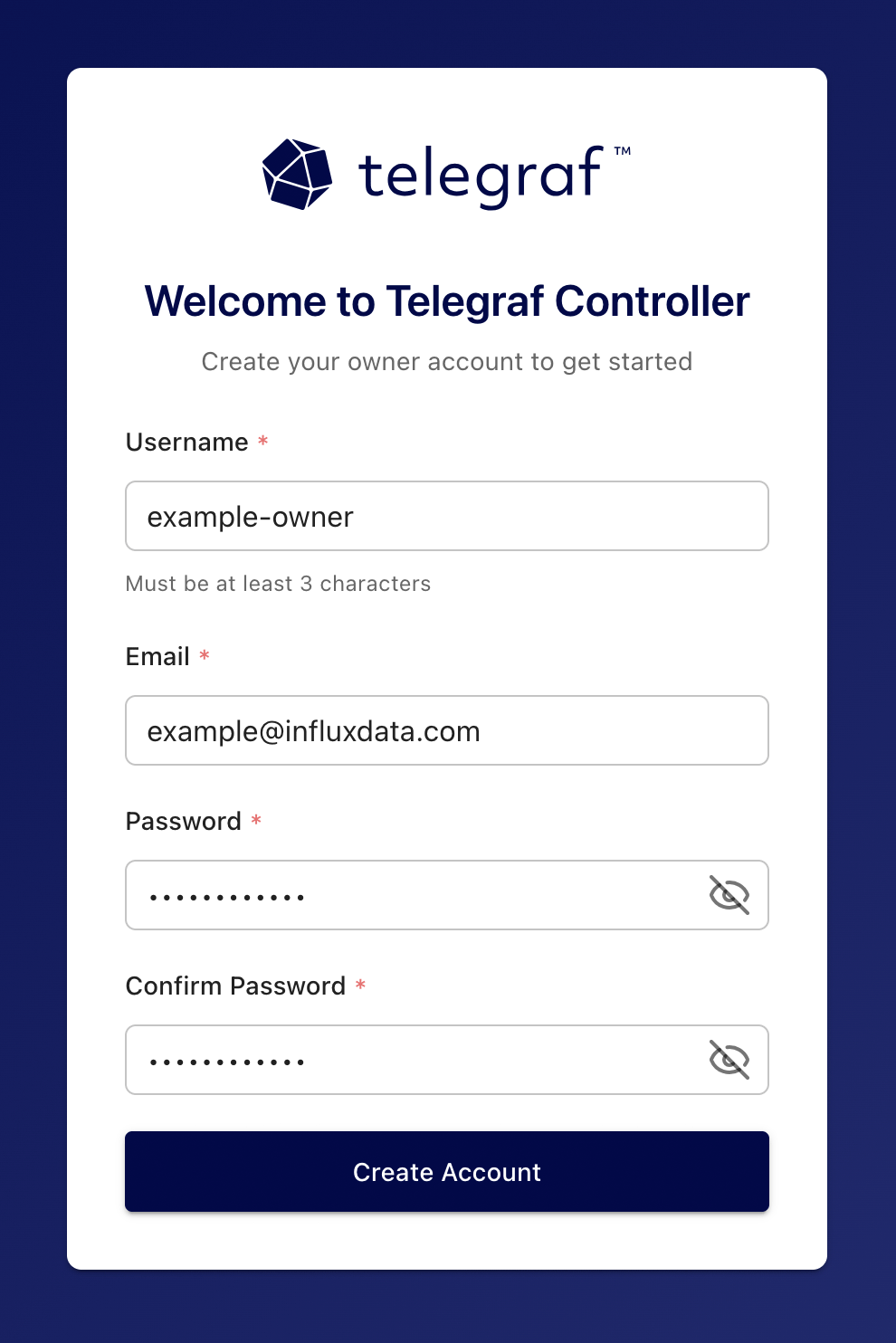
If no owner account exists when you start Telegraf Controller in non-interactive mode, the web interface displays a setup page where you can create one.
- Navigate to the Telegraf Controller URL in your browser.
- Fill in the Username, Email, and Password fields.
- Click Create Account.
For more information about user roles and permissions, see Authentication and authorization.
Apply a Telegraf Enterprise license (optional)
If you have a Telegraf Enterprise
license, you can apply it at startup by setting the LICENSE_FILE_PATH
environment variable to the path of your license file.
export LICENSE_FILE_PATH=/etc/telegraf-controller/license.jwtYou can also apply a license through the Telegraf Controller UI after the application is running. For full details on both methods, including systemd and Docker examples, see Apply a license.
Without a license, Telegraf Controller runs in a free tier with reduced scale limits and enterprise features disabled. See Telegraf Enterprise for a comparison.
Access Telegraf Controller
Once started, access the Telegraf Controller web interface at
http://localhost:8888 (or using your custom port). If you set
ui-port to serve the
web interface on a separate port, use that port instead.
If the server does not start or you cannot access the web interface, see Troubleshoot Telegraf Controller.
Was this page helpful?
Thank you for your feedback!
Support and feedback
Thank you for being part of our community! We welcome and encourage your feedback and bug reports for Telegraf Controller and this documentation. To find support, use the following resources:
Customers with an annual or support contract can contact InfluxData Support.