Documentation

List tables

Use the Admin UI, the influxctl table list command, the SHOW TABLES SQL statement, or the SHOW MEASUREMENTS InfluxQL statement to list tables in a database.

With InfluxDB Cloud Dedicated, tables and measurements are synonymous.

The InfluxDB Cloud Dedicated administrative UI includes a portal for managing tables. You can view the list of tables associated with a database and their details.

Access the InfluxDB Cloud Dedicated Admin UI at console.influxdata.com. If you don’t have login credentials, contact InfluxData support.
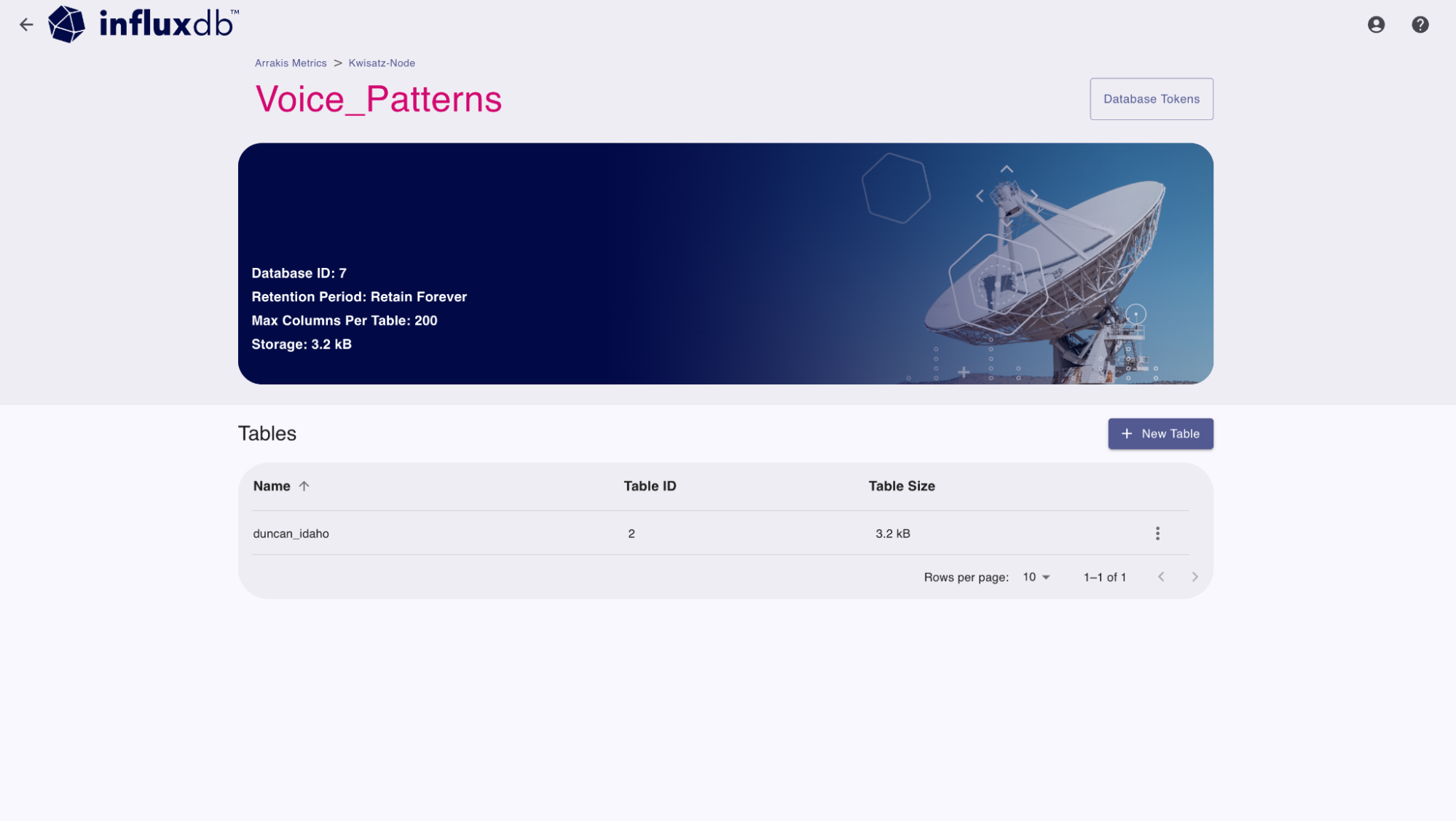
InfluxDB Cloud Dedicated Admin UI tables list

Use the Tables page to manage tables within databases:

  • Select a database from the dropdown to view its tables.
  • View table IDs and sizes.
  • See database size summary.
  • Create new tables.
  • Access detailed table schema information.

You can Search for tables by name or ID to filter the list and use the sort button and column headers to sort the list.

Use the influxctl table list command to list all tables in a database in your InfluxDB Cloud Dedicated cluster.

influxctl table list 
DATABASE_NAME

Replace the following:

  • DATABASE_NAME: Name of the database containing the tables to list

Output formats

The influxctl table list command supports the following output formats:

  • table (default): Human-readable table format
  • json: JSON format for programmatic use

Use the --format flag to specify the output format:

influxctl table list --format json 
DATABASE_NAME

List tables with the influxctl query command

To list tables using SQL or InfluxQL, use the influxctl query command to pass the appropriate statement.

SQL

SHOW TABLES

InfluxQL

SHOW MEASUREMENTS

Provide the following with your command:

  • Database token: Database token with read permissions on the queried database. Uses the token setting from the influxctl connection profile or the --token command flag.
  • Database name: Name of the database to query. Uses the database setting from the influxctl connection profile or the --database command flag.
  • SQL query: SQL query with the SHOW TABLES statement or InfluxQL query with the SHOW MEASUREMENTS statement.
SQL
influxctl query \
  --token 
DATABASE_TOKEN
\
--database
DATABASE_NAME
\
"SHOW TABLES"
InfluxQL
influxctl query \
  --token 
DATABASE_TOKEN
\
--database
DATABASE_NAME
\
--language influxql \ "SHOW MEASUREMENTS"

Replace the following:

  • DATABASE_TOKEN: Database token with read access to the queried database
  • DATABASE_NAME: Name of the database to query

Was this page helpful?

Thank you for your feedback!


InfluxDB OSS 2.9.0: API tokens are hashed by default

Stronger token security in InfluxDB OSS 2.9.0 — tokens are hashed on disk by default. Existing tokens are hashed on first startup and can’t be recovered afterward. Capture any plaintext tokens you still need before you upgrade.

View InfluxDB OSS 2.9.0 release notes

Hashed tokens authenticate exactly like unhashed tokens — clients and integrations keep working.

Also new in 2.9.0:

  • Configurable backup compression
  • Restore support for backups containing hashed tokens
  • Tighter Edge Data Replication queue validation
  • Flux upgrade
  • Compaction reliability improvements

Key enhancements in Explorer 1.8

Explorer 1.8 is now available with streaming data subscriptions (beta), line protocol preview, and query history & saved queries.

View Explorer 1.8 release notes

Explorer 1.8 includes new features and improvements that make it easier to ingest, explore, and manage data.

Highlights:

  • Streaming data subscriptions (beta): Stream data into Explorer from MQTT, Kafka, and AMQP sources.
  • Line protocol preview: Preview line protocol, schema, and parse errors before data is written.
  • Custom sample data: Generate custom sample datasets with line protocol and schema preview.
  • Query history and saved queries: Browse query history and save/re-run named queries.
  • Retention period management: Set, update, or clear retention periods on databases and tables.

For more details, see Explorer 1.8 release notes

InfluxDB 3.9: Performance upgrade preview

InfluxDB 3 Enterprise 3.9 includes a beta of major performance upgrades with faster single-series queries, wide-and-sparse table support, and more.

InfluxDB 3 Enterprise 3.9 includes a beta of major performance and feature updates.

Key improvements:

  • Faster single-series queries
  • Consistent resource usage
  • Wide-and-sparse table support
  • Automatic distinct value caches for reduced latency with metadata queries

Preview features are subject to breaking changes.

For more information, see:

Telegraf Enterprise now in public beta

Get early access to the Telegraf Controller and provide feedback to help shape the future of Telegraf Enterprise.

See the Blog Post

The upcoming Telegraf Enterprise offering is for organizations running Telegraf at scale and is comprised of two key components:

  • Telegraf Controller: A control plane (UI + API) that centralizes Telegraf configuration management and agent health visibility.
  • Telegraf Enterprise Support: Official support for Telegraf Controller and Telegraf plugins.

Join the Telegraf Enterprise beta to get early access to the Telegraf Controller and provide feedback to help shape the future of Telegraf Enterprise.

For more information:

Telegraf Controller v0.0.7-beta now available

Telegraf Controller v0.0.7-beta is now available with new features, improvements, bug fixes, and an important breaking change.

View the release notes
Download Telegraf Controller v0.0.7-beta

InfluxDB Docker latest tag changing to InfluxDB 3 Core

On May 27, 2026, the latest tag for InfluxDB Docker images will point to InfluxDB 3 Core. To avoid unexpected upgrades, use specific version tags in your Docker deployments.

If using Docker to install and run InfluxDB, the latest tag will point to InfluxDB 3 Core. To avoid unexpected upgrades, use specific version tags in your Docker deployments. For example, if using Docker to run InfluxDB v2, replace the latest version tag with a specific version tag in your Docker pull command–for example:

docker pull influxdb:2